Neil Greenberg’s Slippery Realities
Brendan McCall, The Gay & Lesbian Review
Brendan McCall, The Gay & Lesbian Review
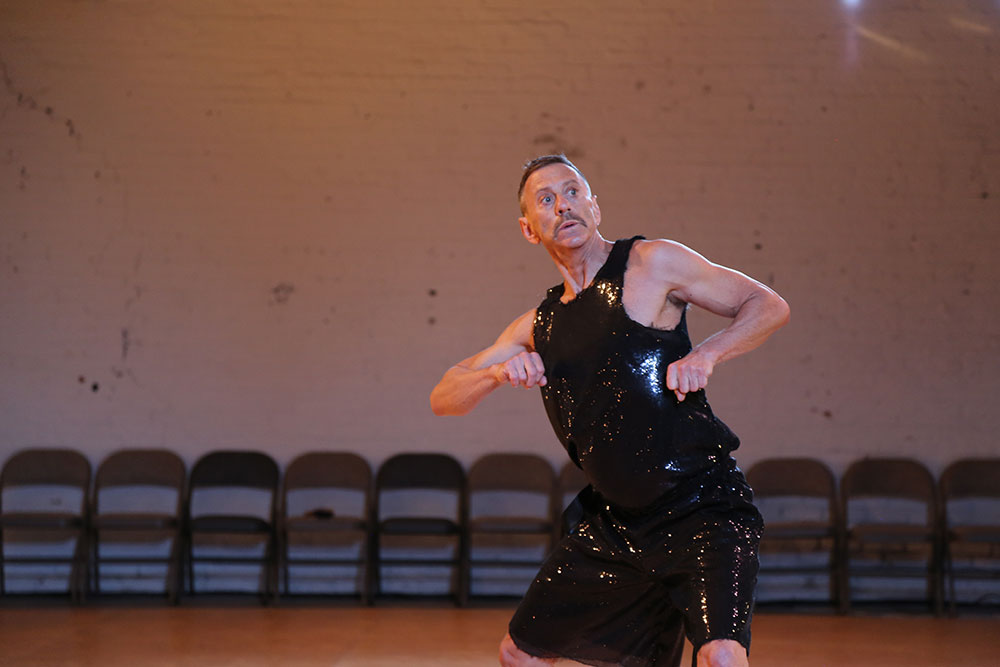
Neil Greenberg is a New York City-based dance artist who performed with the Merce Cunningham Company from 1978-86 and began choreographing and presenting his own work in 1986. He’s often associated with Not-About-AIDS-Dance, his 1994 piece that encapsulates both his distinctive contemporary modern dance vocabulary and his use of projected text and film. His most recent work was Betsy (2022) at La MaMa.
His husband, visual artist Frank Mullaney, died of cancer in February, and this spring Greenberg accepted early retirement from the New School, where he had been teaching full-time since 2010. He recently premiered a new evening-length work at The Chocolate Factory Theater, which runs from November 12-21.
Brendan McCall caught up with Greenberg at his Chelsea apartment in October.
Brendan McCall: Your new piece is called Next Dance. Tell me a bit about it.
Neil Greenberg: So “next,” like “the next of it”: I like how that situates something in the body of the work. It’s a duet for three dancers. In addition to myself, there’s Jennifer Lafferty, who worked with me on The Disco Project Remix (2022-23), and Owen Prum, who danced in Betsy. Zeena Parkins and James Lo are working with me again on the music, and Next Dance contains some new, beautiful, full harp pieces. Though she is the inventor of the electric harp, this will feature Zeena’s acoustic work.
BM: I’m curious about what artistic questions you’re exploring this time.
NG: Continuing from Betsy, I’m really interested in the relationship with the viewer. I’ve had that interest since before that became such an explicit part of the work. People are always performing a multitude of things: masculinity, femininity, gender fluidity, and so on.
BM: What you’re saying reminds me of performance studies.
NG: Right. Onstage, there’s some kind of relationship going on, even if that is “I don’t want you to know that I know that you’re there.” I’m doing this fourth-wall stuff, but it’s still a fiction. So I think I’m proposing that there is really something about performing that is there, in addition to time and space. When I performed with Merce Cunningham, he would talk about time and space, about inhabiting the movement as choreographed, doing it without it being something else. But Merce was such a performer! When I danced with him, I liked having the moment pass through me, and that included my face sometimes, like he would do.
BM: That’s such an interesting point. We look at these pioneering artists from the past, and we’re gleaning information from books, from written information about time and space, chance operations, postmodernism, and we get this very intellectualized, academic notion about the work. But then if you were to see Merce’s Gallopade (1982), then you think: “Oh wait. I thought this was abstract, from a non-feeling artist.” You discover there’s a lot of warmth and playfulness and invention going on there.
NG: Next Dance has an incredibly tight structure, but within that, there’s this opportunity to play too—with the movement material, with ourselves, with the audience. What we are doing movement-wise is so studied. We choose segments, try to learn the material as close to how we improvised it as possible. And then the performers riff off that a little bit. We’re trying to meet this specific thing, and of course it’s impossible to meet it completely. We work so hard to get the detail and nuance. All the movement comes from video-recorded improvisations that we’ve each done solo, although we have talked about some ideas beforehand having to do with performance and the gaze.
BM: What do you mean, “the gaze”?
NG: I’m not talking only about your hairdresser. [laughs] I’m talking about the eyes, how that becomes a technical aspect of different performance states and different ways of creating a relationship with whom you’re watching. Which might even be, “I’m not looking at them.” Some of these gaze ideas are part of the improvisations. We have to decode that, too. “This is the part where we’re working directly with the audience, looking at them wherever possible and creating something.”
BM: It sounds like you’re asking what is fiction, what is not, and that is very timely. We’re swimming in this cultural sea where things are made to look authentic but are actually highly curated and artificial.
NG: I’m not creating a cohesive fiction. I am letting the audience know that no matter how carried away I get with the performance of this movement, and that maybe some kind of fiction arises, that I can drop that. From early on, with MacGuffin, or How Meanings Get Lost (1987), I was playing with the slipperiness of meaning. I have an attraction to meaning not being set in stone.
BM: Congratulations on winning the Ruthie Award this year. [The Ruth Maleczech Award “for performers who embody Ruth’s daring and raw, naked, fearlessness in every performance,” a cash prize presented by Mabou Mines, “a collaborative hub for diverse, avant-garde theater artists” in New York City that was cofounded by Maleczech.] In that speech you acknowledged people who had an impact on you, like Mabou Mines, John Jesurun—
NG: —and the drag and trans performers at The Anvil—
BM: The Wooster Group…
NG: I’m a real Wooster Groupie! I’ve been seeing their work since Route 1 and 9 (1981), which caused a lot of controversy. They have this quality where they’re winking at the audience while acting. Like, “Oh! You mean I’m not supposed to just stay in the suspension of disbelief!?” [laughs] Slipperiness!
BM: Like some of Richard Foreman’s work.
NG: [nods]And you have to add Jeff Weiss to the list. He was doing these narrative serial extravaganzas! There was no center; it wasn’t trying to be austere. It was trying to be maximalist, without all the money.
BM: It seems like a lot of artists then were questioning how art was made: how is a piece being seen, what is not being seen.
NG: I’m interested in the work that performs something but doesn’t say something. The performance is an object that is there to be experienced differently by everyone.
BM: Congratulations, too, on retiring from the New School. How is that new identity affecting you in the development of this project?
NG: I love it! I really do. I didn’t know I’d love it. I mean, I’m creating work, and I already had Next Dance set up for this time whether I was teaching or not. But the other thing about this time is that my husband Frank, of 29 years, died in February.
BM: I’m very sorry about that.
NG: Thank you. So that’s kind of what this fall is about too. Next Dance was supposed to be performed in November 2025, but then Frank got sick with lung cancer, and so I just had to stop rehearsals and postpone the performance. When we started up again in July, we already had a base, but it was very strange, that first rehearsal—after the memorial and after Frank’s exhibition of “Wallpaper Saints.” All its LGBTQ+ subjects are done like saint cards from the Catholic Church. But the social aspect of choreography and dancing—it’s just wonderful. I felt so supported. So I don’t know if I really know what retirement is going to feel like yet.
Brendan McCall for The Gay & Lesbian Review – November 14, 2026