NEAL MEDLYN with Sarah Cecilia Bukowski
Sarah Cecilia Bukowski, The Brooklyn Rail
Sarah Cecilia Bukowski, The Brooklyn Rail
Imagine for a moment how you might inhabit the world of Britney Spears. Phil Collins? Beyoncé? Insane Clown Posse? The performance artist Neal Medlyn has done it all (and then some). Medlyn’s performances are singular events that traverse popular sensibilities and creative disciplines with undercurrents of philosophical curiosity and devotional irreverence. His “Pop Star Series” grew from a fascination with the interplay between the artifice and interiority of celebrity personas, running parallel to his original music and cabaret-style shows under the alias Champagne Jerry. More recently, Medlyn’s “Death & Dying” series expanded his thematic focus to channel elements of his theological studies through pop culture references and personal narrative.
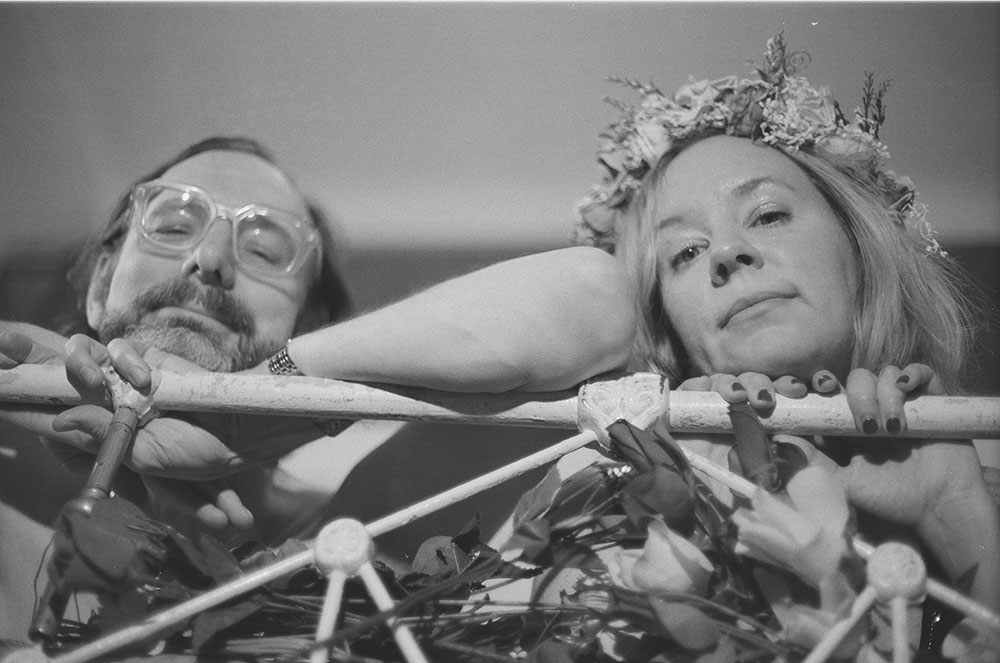
On March 25, Medlyn will further extend his creative arc with Made in Heaven, an interdisciplinary work created in collaboration with visual artist Ulrika Andersson and presented by the Chocolate Factory Theater. The work nods to Jeff Koons’s 1989–91 painting and sculpture series of the same name, which featured Koons with his then-wife Ilona Staller, also known as the adult film star Cicciolina, in baroquely-styled, sexually explicit tableaux. Koons’s work and its attendant controversies serve as a jumping off point for Medlyn and Andersson to contend with the tensions between surface and substance in the realm of the erotic.
Performer and arts writer Sarah Cecilia Bukowski speaks with Medlyn on tracing themes of sex, death, and the divine through his life and work, and what it means to hold something sacred in the medium of performance.
Sarah Cecilia Bukowski (Rail): Your work explores a range of ideas across various media, but music and musicians are often at the center. What kinds of possibilities does music open for you?
Neal Medlyn: I did theater in high school and college, but I was most interested in music. I was originally in bands and first started having performance ideas based on playing music. At the time, Kathleen Hanna, who was a big influence on me when I was young, started this band called Le Tigre, and it was like radical pop music. That’s how I realized that pop music was what I wanted to focus on, because that’s what I have this relationship with, and I could try to use that in my shows. At first I’d make myself a mixtape, and that would be the music for performances. The music ensured that I would actually go on stage, because I liked the song, so I knew I’d go up there and not freak out, like if I had to talk or dance or something.
Rail: Elements of pop culture can often be at odds with religious doctrines, and your work plays on these tensions to shed light on the deeper connections between these worlds. How did your upbringing in the Pentecostal church influence your creative development?
Medlyn: My parents’ church was an ecstatic church, so there was a lot of music, singing, clapping and shouting, and speaking in tongues. Much later, when my dad came to see one of my shows, I was really nervous about him seeing my work, so I had my friends prepare him for it. And the next day we went on a walk, and he was like, “I don’t know why everyone was trying to prepare me for this—this is what you’ve been like since you were a kid. This is the world you grew up in.” That’s when I really started to put it together, the overlap between growing up in this ecstatic version of Christianity and what I was interested in as a performer—and even how I perform, the way I move my body when I’m performing—it’s very influenced by all of that. I think there’s a historical tie too. A lot of rock and pop performance as a physical vocabulary clearly comes from the Black church and ecstatic traditions and Southern Christianity writ large, so it makes sense on many levels.
Rail: What’s your relationship to your body in performance? What does your body give you, and how has it changed?
Medlyn: For most of the time I’ve been a performer, the way I approached it was that I knew the song or what I had planned was gonna get me to a place where I would just kind of freak out. And that would be so dramatic that it would be the whole idea. Sometimes there wouldn’t even be much of a concept to the performance beyond that, so it was very much this ecstatic model where this thing was gonna take me over and then I’ll be exhausted and it’ll be over. Now I’m much more interested in the way performers—as they age or change—continue to put things together: how they adapt and still get some kind of reaction from the crowd for doing something physical without it being extreme. Since the pandemic, my work has had a lot more about age and movement and performance as a conceptual thread than it did before. It’s being aware of how much you have to do and how much you don’t have to do to make something work. So that became the interest to me: learning a vocabulary of moves based on whatever the show might be, and whoever the subject might be, and dealing with that. That’s always been interesting to me, but when I was younger, I was just letting my body go, and that would be the choreography. Now it’s much more like, “What are these vocabularies that I can use to get this across and not pass out?”
Rail: Your upcoming show, Made in Heaven, takes Jeff Koons’s work as a point of departure. Koons isn’t a pop star in the musical sense, but he is something of a pop star in the art world. What attracted you to him, and to this work in particular?
Medlyn: My father-in-law, who was an art critic for The New Yorker, told me how Jeff Koons did this really weird thing called Made in Heaven, where he married this Italian porn star, and they made all these gigantic paintings of them having sex, but it was unnerving, partly because in every one of them, Jeff Koons is looking out of the canvas directly at you. And it was really weird and everybody hated it. And that was really interesting to me, because I love when you attempt to do something artistic and it doesn’t go the way that you think it’s going to. I enjoy that when it happens to me. It’s kind of funny or interesting, or it’s annoying or angry-making, or disappointing. I have an interest in art that doesn’t quite work out.
Rail: How are you working with your primary collaborator, Ulrika Andersson?
Medlyn: When we started out, there was this idea that Ulrika was gonna do the visual look of the show and that I was gonna do the music and performance parts. But it’s really become much more collaborative as we’ve worked on it, and that has formed this other layer of the Made in Heaven aspect, which is that she’s a visual artist and I’m a performance artist; Ciccolina was a performance artist, Jeff Koons was a visual artist, and I feel like that’s become almost accidentally—but in a really great way—how the show is working out with me and Ulrika. Besides the two of us, there are a lot of performers in the show, there’s a lot of video, there’s a band, there’s music by a variety of people and some pre-recorded music, so many different things are happening.
Rail: What are you pulling from in your musical choices?
Medlyn: Some of it comes from early ideas of what sexuality sounds like. So Barry White is in there, because when I was a kid, you would hear Barry White, and—even though I was too small to know what it was—I was aware that whatever that is, it’s adult and romantic. And then also my deep and abiding interest in the film Magic Mike XXL means that there’s a lot of Jodeci and Ginuwine, some music from my older shows, and a couple tracks Ulrika brought from Trainspotting. There’s some club music, because one of my ancillary projects is to make a gigantic playlist of all the songs that have people moaning in them. Trying to find them all was kind of fun, like, how do you Google that? Or how do you listen for that? So while I was compiling that, I ran across all these other kinds of music and other interesting things that could fit in somewhere. Of the shows I’ve made in the last while, I’m pulling from the most different kinds of places, and I think it’s because the topic is in some ways the most difficult to wrestle with.
Rail: You wrestle pretty regularly with big ideas in your work. How does Made in Heaven relate to some of your previous work?
Medlyn: Well, I had made these shows about death, I had made a big series of works about God, and I figured I should do the third big topic: sex. So Made in Heaven was a way into that. What I like about it is this way in which sex is performative—you don’t know what this thing is going to be, you don’t know how it’s going to play out, but it has this potential to really transform you. Often art that’s about sex is descriptive, or it’s sort of a reenactment, but I’m interested specifically in the weirdness of it—not the graphicness or the media narrative, or what it means socioculturally. I’m interested in how potentially transformative, scary, funny, and kind of accidental and ad hoc it is.
Rail: Sex shows up in so many ways in the media and in our lives, and of course it gets caught up with death and the divine. Your last large-scale work, HOLY SATURDAY (2024), took place at a General Theological Seminary and drew on your studies there. Are you carrying those interests into this work?
Medlyn: Yes, there is some explaining of the theological feelings I have about nightclubs and sex work, about being a performer and aging, kind of theologically looking at all of those things via the lens of Magic Mike XXL. One of the things that I was thinking about with Magic Mike and club performing is that what you’re doing—which is also true of ecstatic spirituality—is trying to get up to a specific high point, and you’re freezing some kind of pleasure or ecstasy at that moment. And whatever that thing is, whether it’s Magic Mike giving somebody a lap dance, or what happens in church or at a nightclub with the long buildup to the beat dropping—the moment you hit that, that’s a performative, artistic, personal thing. And to freeze that moment is like a glimpse of a heaven that stretches backward and forward through time. There’s something in why we always set those things apart in these certain kinds of places, because we couldn’t handle our day-to-day lives if all this was just happening on street corners. It’s got to happen in these special places—whether that’s in a gay bar or a nightclub or a performance space or a church—then it can be framed in a way where we can have that experience.
Rail: And there’s something about the collectivity of it too—that it’s something shared. What’s that experience like for you as a performer?
Medlyn: This is why I like the term “performance art,” because the art that I make is really just the performance. It’s not what goes into the performance, it is the act of performing. My work doesn’t have any reality outside of what’s happening when the people are there, because the audience is the other half of whatever it is that’s occurring. And that relationship is ad hoc: these people are bringing individually and collectively, whatever they’ve experienced from their day, from their week, from their feelings about me, whether I’m doing it correctly or not. And I’m doing that too—that’s the show. I think there’s a spiritual correlative to that, and there’s a sexual correlative as well—like you meet somebody at a bar and you’re having a good conversation, so maybe we can do this crazy insane thing. And then it’s like, “Did that work? Did it not work?”
Rail: Are some of those feelings behind your choice to present Made in Heaven in a single evening?
Medlyn: At first I thought I’d do it three times, and then I was like, “Wait, why would I do it more than once?” It would be three different things, and that’s not really what I’m interested in. I’m interested in it being a thing that occurs, and then you go on with your life. It helps me live as a person too. So every time I’m making something, I’m just living out my life as making art. This will be my 127th original show—I’m always making different things because that’s what I like doing.
Sarah Cecilia Bukowski for The Brooklyn Rail, March 2026